


Ask any front desk agent, and they’ll tell you the same story. A repeat guest arrives expecting recognition, only to be treated like a first-time visitor. Not because the hotel doesn’t care, but because its systems don’t connect. The guest exists simultaneously in the PMS, CRS, spa system, restaurant POS, CRM and loyalty platform. But nowhere do they exist as a single, unified identity.
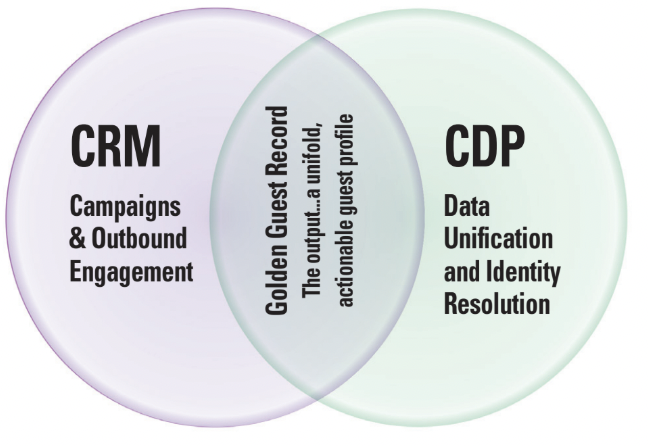
This is the problem the industry has long tried to solve through what is often called the “Golden Guest Record” (or Golden Profile), a single, authoritative, continuously updated view of each guest. And yet, despite decades of investment in CRM, PMS and now CDP technologies, most hotel organizations are still far from achieving it.
What Is the “Golden Guest Record”?
At its simplest, the Golden Guest Record is a single source of truth for guest identity. An aggregated, cleansed and continuously reconciled profile that brings together every interaction a guest has had with a hotel brand. This includes:
- Stay history across properties
- Spend across outlets (rooms, F&B, spa, golf, etc.)
- Channel behavior (OTA vs. direct vs. corporate)
- Preferences and service requests
- Marketing engagement and consent
- Loyalty status and lifetime value
In theory, this unified profile enables hotels to shift from transactional operations to true guest-centricity, driving personalization, loyalty and revenue.
In practice, however, the Golden Guest Record remains more aspiration than reality.
The Root Problem: Fragmented Identity
The fundamental challenge isn’t a lack of data. In fact, it’s too much disconnected data.
Regrettably, hotels still operate within highly fragmented technology ecosystems. A single guest journey may involve:
- Booking through an OTA (with masked email)
- Modifying via call center
- Checking in through PMS
- Spending in POS systems
- Engaging via mobile apps or email marketing platforms
Each system captures a different “version” of the same guest. As a result, hotels often end up with multiple identities for a single individual.
In fact, duplicate profiles are one of the most persistent issues in hospitality, often caused by simple variations. For example: misspelled names, nickname vs. full name, or different booking channels.
The outcome? One guest becomes five records. And five records means zero clarity.
Why Hotels Still Struggle
Despite widespread awareness of the problem, several underlying challenges continue to prevent hotels from achieving a true Golden Guest Record. These include:
Siloed Systems by Design Hospitality technology evolved as a collection of best-of-breed operational systems, not as an integrated ecosystem.
- PMS manages stays
- CRS manages inventory and distribution
- POS manages on-property spend
- CRM/CDP manages marketing
These systems were never designed to share identity seamlessly.
Data silos remain deeply embedded, with guest data spread
over different platforms across the enterprise.
Even modern cloud migrations often replicate these silos rather
than rationalize them.
Channel Complexity and OTA Masking
Distribution has become both a growth engine and an identity problem. Online travel agencies (OTAs) frequently obscure guest contact information, replacing real emails with proxy addresses. This creates multiple, unlinked identities for the same guest across stays.
- “john.smith@gmail.com” (direct booking)
- “abc123@booking.com” (OTA stay #1)
- “xyz789@expedia.com” (OTA stay #2)
Without sophisticated identity resolution, these remain separate records.
Data Quality and Human Input
Hospitality is a global, high-touch industry, meaning guest data is often manually entered across multiple touchpoints. This introduces inconsistencies such as:
- Spelling variations (e.g., Mohamed vs. Muhammad)
- Formatting differences (phone numbers, addresses)
- Language and script variations
- Incomplete or missing fields
These seemingly minor discrepancies significantly complicate identity matching and deduplication.
Legacy, Transaction-Centric Architectures
Most hotel systems are still fundamentally transaction-oriented rather than customer-oriented.
The PMS, for example, is optimized to manage a reservation, not a relationship. As a result, guest identity becomes secondary to the transaction itself.
This architectural bias has persisted for decades, limiting the industry’s ability to build persistent, cross-journey guest profiles.
Privacy, Consent and Compliance Complexity
Modern data privacy regulations (GDPR, CCPA, etc.) introduce additional complexity. Hotels must now manage:
- Consent by channel (email, SMS, etc.)
- Regional compliance rules
- Data retention and deletion policies
A guest may opt in through one system and opt out through another, creating conflicting records that must be reconciled in real time.This makes the Golden Guest Record not just a technical challenge, but a governance challenge.
Organizational Silos
Even when technology exists to unify data, organizationalstructures often prevent it. Marketing, operations, revenue management and IT frequently operate with:
- Different systems
- Different KPIs
- Different priorities
- Different definitions of “the guest”
Without alignment, the Golden Guest Record becomes everyone’ssubjective priority and no one’s responsibility.A guest may opt in through one system and opt out through another, creating conflicting records that must be reconciled in real time.This makes the Golden Guest Record not just a technical challenge, but a governance challenge.
The Cost of Getting It Wrong
Failure to resolve guest identity has both experience and financial consequences.
From a guest perspective:
- Repeat guests feel unrecognized
- Preferences are ignored
- Personalization efforts fall flat
From a business perspective:
- Marketing becomes inefficient and mis-targeted
- Loyalty programs underperform
- Revenue opportunities are missed
Hotels heavily relying on fragmented data not only lose personalization opportunities. They risk losing the guest relationship entirely, particularly when bookings flow through third parties.
Why the Golden Guest Record
Matters More Than Ever The urgency around guest identity is increasing, not decreasing and three macro trends are accelerating the imperative:
- Personalization as a Competitive Differentiator
Guests now expect tailored experiences.
Generic service is no longer acceptable.
- The Rise of AI and Automation
AI-driven recommendations, chatbots and agentic workflows depend on clean, unified data. Without it, AI amplifies errors instead of solving them
- Shift to Guest-Centric Revenue Models
Hotels are moving beyond room revenue to total guest value, spanning experiences, services and lifetime loyalty.
THE TAKEAWAY: From Data to Identity
The hospitality industry doesn’t have a data problem... it has an identity problem.
Solving it requires more than leaning into CRM, deploying a CDP and declaring ‘done’, or simply upgrading your PMS. It demands:
- Smart cross-system integration
- Advanced identity resolution capabilities
- Data governance and consent management
- Organizational alignment around the guest
Only then can hotels move from knowing something about the guest to knowing the guest.
Until that shift occurs, the Golden Guest Record will remain what it has long been: one of the industry’s most important but most elusive goals.