


The day brought together long standing EVS participants, industry leaders, technologists, legal experts and CIOs to explore how artificial intelligence, cybersecurity, data collaboration and shifting economic models are reshaping the hospitality technology landscape.
The programming blended formal education sessions with interactive panels, legal and cybersecurity deep dives, philanthropic initiatives and roundtable discussions, reinforcing EVS’s role as a trusted forum for honest, senior level conversations about the industry’s future.
SUMMIT WELCOME
The day opened with the official Summit welcome and recognition of EVS’s most dedicated attendees. EVS honored two 10 year milestone participants, Mark Haley and David Chetsler, each receiving the traditional 10 year bobblehead in recognition of their long term commitment to the summit.
Attendees celebrating 15 years of participation were also acknowledged, receiving commemorative caricatures from the Executive Vendor Summit.
This year’s 15 year honorees were Frank Pitzikalis of Agilysys, Trevor Warner of Warner Consulting, and Sherry Merek of Aiken Street Consulting. These recognitions underscored the enduring value EVS provides as a forum for peer learning and long term professional relationships within hospitality technology.
The traditional EVS programming formally began with the introduction of the event’s master of ceremonies sponsor, Jeff Bzdawka, CEO of Hapi, who played a prominent role as both moderator and facilitator.
AI IS RESHAPING BUYER EXPECTATIONS BEFORE SALES ENTERS
MICHAEL GOLDRICH
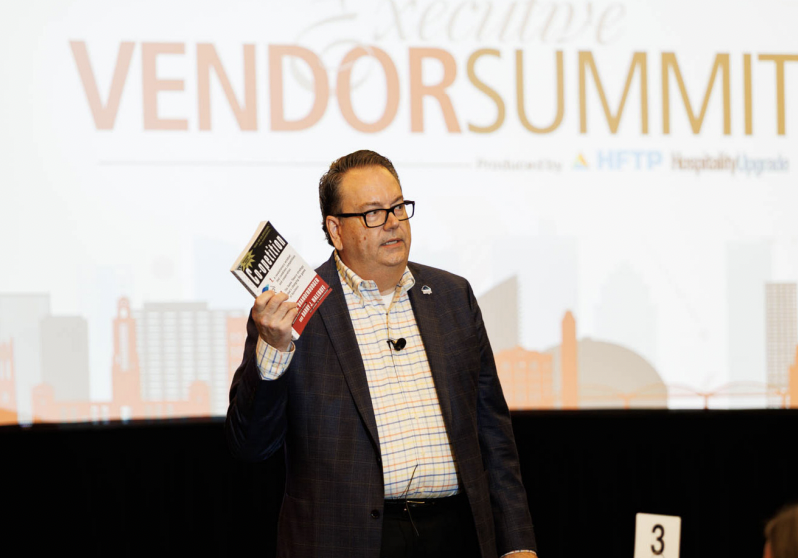
Michael Goldrich opened the educational programming with a timely exploration of how artificial intelligence is fundamentally changing buyer behavior and sales dynamics in B2B environments. He emphasized that first impressions are increasingly formed in spaces where companies have little to no direct control–private AI-driven conversations between prospects and intelligent systems.
Goldrich introduced the concept of the “answer spiral,” which he argued is replacing the traditional linear sales funnel. Rather than progressing through sequential stages, buyers now engage in iterative AI interactions in which each response generates new questions. At each stage of this spiral, a company’s product either appears as a recommended solution or becomes invisible.
He stressed that there isn’t a second chance to influence these impressions once they form within AI-mediated conversations. Visibility depends on how
well a company’s content is structured, cited and recognized as authoritative by AI systems. Citations play a critical role, and while organizations can’t always
control where citations point–whether to their own websites, review platforms or even competitor content–the goal must be to be present, persuasive and credible.
Clear, consistent messaging, recent content and the avoidance of ambiguous language are key factors AI uses when determining credibility. His core takeaway was succinct: consistency plus consistency equals credibility.
Companies that manage their narrative with discipline increase their chances of being surfaced and recommended in AI-driven buyer journeys.
SMILING AT SUCCESS, LAUGHING AT FAILURE
DAVE BERKUS
Dave Berkus followed with a candid and engaging session that blended storytelling with hard earned lessons from his early career in hospitality technology and his later work as an investor and advisor to entrepreneurs.
Through a series of personal anecdotes– some humorous, others humbling–Berkus illustrated how both success and failure have shaped his professional philosophy. He
emphasized that complexity is often a silent killer of companies, particularly in fast growing technology environments.
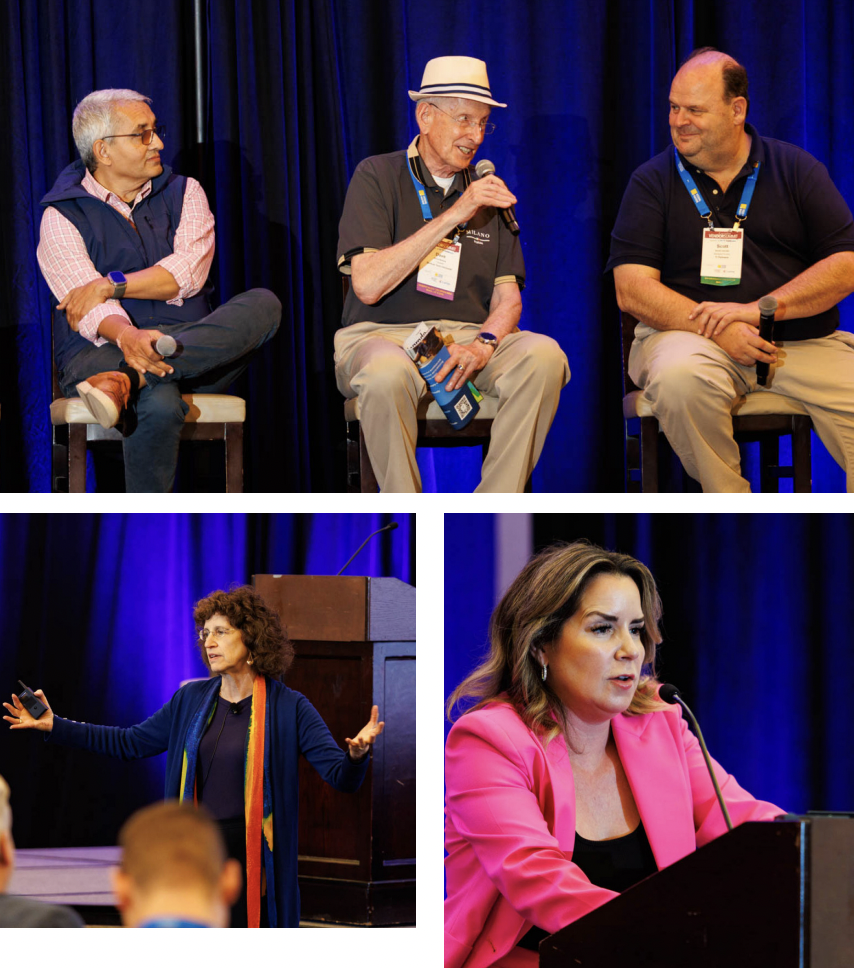
Berkus identified three distinct types of buyers: financial, strategic and emotional, highlighting the importance of understanding buyer motivation when timing and structuring a sale. He reflected on his early career as a “resource capitalist,” a term that has since evolved into what is now more commonly called an angel investor
and highlighted how the ability to recognize opportunity has shifted alongside industry maturation.
The session reinforced the importance of resilience, adaptability and maintaining perspective through both highs and lows.
I’LL TAKE TECH CONTRACTS FOR 800, ALEX! LEGAL JEOPARDY WITH KENDALL
KELLY HAYDEN
The third educational session offered a creative departure from traditional legal presentations. Counselor Kendall Kelly Hayden transformed complex legal topics
into an interactive Jeopardy style game, covering intellectual property rights, privacy clauses, vendor agreements and technology partnership considerations.
Attendees were divided into three teams: the Angry Armadillos, led by David Chesler; the Mushroom Agents, led by Kevin Spruill; and the Invincibles, led by Mike Gray.
Through friendly competition, the teams explored real-world legal risks and best practices in a memorable and engaging format. The final scores reflected a not-so-close
contest, with the Angry Armadillos emerging as the winning team. More importantly, the session successfully demystified legal concepts and reinforced the importance of proactive legal literacy in technology partnerships.
PROFIT FIRST: RESPONDING TO A FUNDAMENTAL SHIFT IN HOTEL ECONOMICS
CINDY ESTIS GREEN
Cindy Estis Green delivered one of the day’s most analytically rich sessions, addressing significant structural changes in hotel economics. She began with the assertion
that “where there’s mystery, there’s margin,” framing data and transparency as essential to navigating today’s hospitality landscape.
Green explained that how hotels are funded, operated and filled is undergoing a profound transformation, driven by data, technology and rising distribution costs. With more than $20 billion projected in OTA marketing spend by 2026, she argued that hotels can’t compete with third party platforms on spending alone.
Artificial intelligence further complicates the booking landscape, with Green predicting that AI dominance will be concentrated among only a few major platforms. In this environment, visibility becomes critical.
She likened AI to a concierge that requires three core inputs: content, customer experience and data. Green also highlighted key performance trends, noting declines in ADR growth, shifts in RevPAR performance and forecasted challenges for 2026. Occupancy was projected to decrease by 1.6%, ADR to rise marginally by 0.8% and RevPAR to decline by 1.0%. Notably, Thursday to Sunday stays were holding RevPAR more strongly than in the pre COVID era, signaling shifting
demand patterns.
Customer acquisition costs have risen dramatically, now accounting for 20–30% of guest paid revenue–second only to labor costs.
Green emphasized that these figures represent a structural, not cyclical, change to the industry. She challenged technologists in the room to consider how innovation could reduce friction, improve returns and restore hotel profitability in a rapidly evolving ecosystem.
CYBERSECURITY IS GUEST SAFETY: PROTECTING HOTELS AND TRAVELERS
CHRISTOPHER WILDER
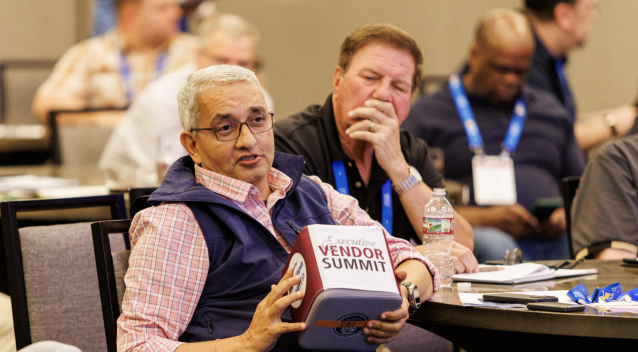
Following lunch, Christopher Wilder addressed cybersecurity as an integral component of guest safety. He outlined the growing sophistication of attacks targeting hotel technology ecosystems, including recent incidents in Las Vegas following the Black Hat conference. Wilder highlighted social engineering as one of the most prevalent threats and emphasized best practices such as never paying ransoms and regularly changing passwords. He discussed the increasing consolidation of hacking groups, many of which are linked to nation state actors including Russia, Iran and China. He noted a sharp increase in attacks following geopolitical instability, particularly in the Middle East.

A particularly sobering segment addressed emerging threats such as agentic AI attacks and quantum computing. While traditional attacks may take months to detect, AI driven attacks significantly reduce detection windows and quantum enabled attacks could be nearly instantaneous.
Wilder also touched on the responsibility of hotels to recognize and respond to human trafficking, emphasizing the critical role front desk staff can play in identifying warning signs. He concluded by stressing the importance of securing Wi-Fi networks, adopting zero trust security frameworks and implementing multifactor authentication as foundational safeguards.

FINDING A BETTER WAY TO WORK TOGETHER: DATA, AI AND HOSPITALITY
MODERATOR: JEFF BZDAWKA
This panel brought together senior leaders to discuss collaboration, data sharing and AI adoption. Panelists included Richard Bradbury of Quore, Laura Calin of Oracle Hospitality and Patty Jefferson of Visual Matrix.
A central theme was the evolving definition of the customer. Panelists debated whether product development should prioritize owners, brands, guests or ecosystem partners. Consensus emerged around the need for collaboration across the hospitality ecosystem to unlock the full value of shared data.
The discussion also addressed the challenges of complexity, AI adoption and change management. Panelists highlighted the importance of cooperation over competition among vendors, particularly when serving mutual customers.

VENDOR ROUNDTABLE DISCUSSION
LED BY SHERRY MAREK
The annual Vendor Roundtable provided an open forum for candid discussion on regulatory challenges, AI dependency and the evolving role of industry events. Topics included European AI restrictions, concerns about overreliance on automated systems and the future of junior technical talent.
Attendees debated the relevance of traditional trade shows in the age of AI, addressing issues such as event duration, audience quality and the effectiveness of pay-to-play models. Several participants noted declining ROI from some brand hosted events and shifts toward selective or alternating attendance strategies.
The day concluded with a networking event at River Ranch Stockyards, celebrating Texas hospitality with a relaxed, culturally immersive evening. Activities included a casual buffet dinner, live entertainment and team building experiences that reinforced the sense of community fostered throughout EVS.
ANNUAL CIO PANEL
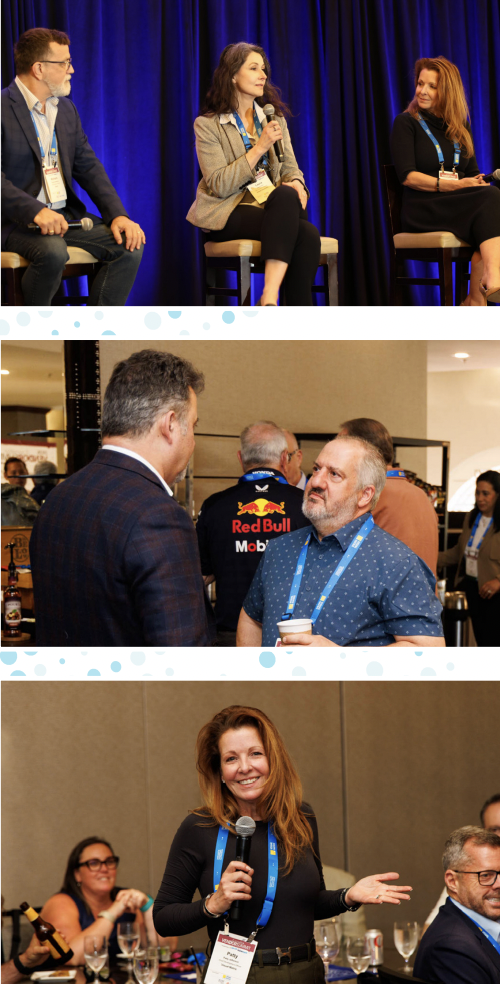
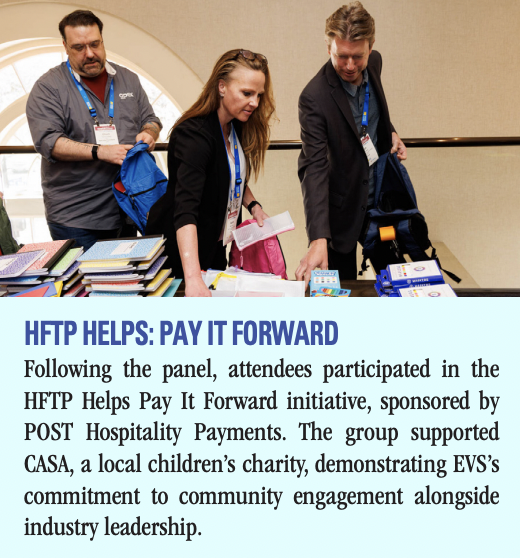
Friday morning featured the highly anticipated CIO Panel, with leaders from Aimbridge Hospitality, Brandt Hospitality Group, Extended Stay America, Omni Hotels & Resorts and Remington Hospitality, and moderated by Jeff Bzdawka.
Discussion centered on AI as an enabling tool rather than a replacement for human connection. Panelists emphasized the importance of using technology to remove friction, support associates and enhance guest experiences rather than over-automating hospitality.
Labor challenges, data overload, dashboard fatigue and vendor collaboration emerged as recurring themes. CIOs called for more integrated data sharing, fewer disconnected dashboards and stronger vendor partnerships focused on operational outcomes.
The session concluded with a call for vendors to prioritize collaboration, transparency and experience-driven innovation–principles that resonated strongly with the broader themes of the Summit.
CONCLUSION
The 2026 Executive Vendor Summit reinforced the urgency of adaptation in an industry undergoing structural transformation. Across sessions, speakers emphasized that success in hospitality technology will depend on collaboration, clarity of narrative, responsible AI adoption and a renewed focus on people– both guests and associates. EVS once again demonstrated its value as a forum for meaningful dialogue, trusted relationships and forward-thinking leadership
Thank you to our 2026 EVS sponsors – Visual Matrix, CallTek, and POST Hospitality Payments.